
Fixing University Visibility in Zero-Click Search
Early in 2024, search engine optimization (SEO) performance was smooth sailing. Organic visibility and traffic were booming for universities. Then, without warning, Google upended its organic search engine results pages (SERPs) with the addition of a new feature: AI Overviews. Long hypothesized by SEO experts such as Rand Fishkin, zero-click search seemed to be upon us.
The addition of that feature accelerated zero-click search — where users find answers on the SERP without having to visit a website. Google would subsequently roll out new AI-driven features across the U.S., including both AI Mode and Gemini. Since these additions, universities and websites across all industries have witnessed a monumental shift in user experience and search behavior.
In this article, I’ll look to provide university leaders with a deeper understanding of this shift and how to engage prospective students in a search landscape that deemphasizes the need to click through to institutional websites.
Get Higher Ed Marketing Insights in Your Inbox
"*" indicates required fields
The Invisible Drop-Off in Modern Enrollment
With the addition of new search features, users attained new ways to research their higher education journeys. According to an online study, “50% of prospective students use AI tools at least weekly” and “79% read Google’s AI Overviews when they appear.”
What was once a relatively straightforward path to discovery now has new branches, which can severely impact website traffic. Users are engaging with your brand before they ever visit your site. Universities are now dependent on third-party systems to accurately reflect the value their programs provide students.
This new evaluation system provides new challenges for universities. What happens when AI misrepresents a program offering? The above study indicates that prospective students are more likely to trust brands that are cited by these systems. What happens then when your university doesn’t appear at all?
Why Traditional Metrics Miss the Problem
Artificial intelligence tools such as AI Overviews, AI Mode, and large language models (LLMs) — including ChatGPT, Claude, Gemini, and Perplexity — summarize content across the web and provide users with answers to their queries directly on SERPs or within a chat interface.
These systems aren’t like traditional search engines. They don’t encourage a click to your site. According to Search Engine Journal, 43% of citations in AI Overviews lead to other Google properties.
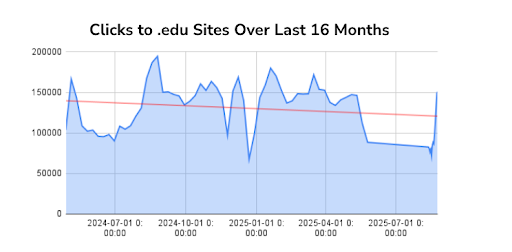
The lack of external website citations and links has led to a decline in organic click-throughs. An Archer study shows a 25% drop in clicks to .edu sites in September 2025 compared with the previous year.
During that same time frame, impression counts were inflated due to AI bots surfacing content to train models. That suddenly gave way, and impressions dropped by 47% across 87% of websites. What were once great indicators of organic health were no longer accurate benchmarks for success.
On the conversion front, there’s been a change in organic lead flow and quality across schools. When looking at enrollments, universities remained relatively steady during that time frame. Though with no inquiry growth and an increase in stealth applications, it becomes harder to nurture prospective students through enrollment pipelines.
How AI Becomes the First Admissions Officer
When I think about successful admissions teams, they do one thing really well: ask great questions. AI systems follow a similar pattern, using web content to answer prospective students’ questions. They use a technique called “query fan-out” to provide conversational paths that help prospective students evaluate whether a program is right for them.
AI is now a crucial touchpoint in decision-making and answers some of the questions a traditional admissions team would. And just as with our admissions teams, accurate responses depend on content and training materials that answer a breadth of questions.
How Does AI Answer Prospective Student Questions
When looking at AI systems, some search marketers believe they’re no different than traditional search engines. LLMs use much of the same technological stack. I believe that good SEO will get you 80% of the way in LLMs, but the remaining 20% formulates answers in a new way.
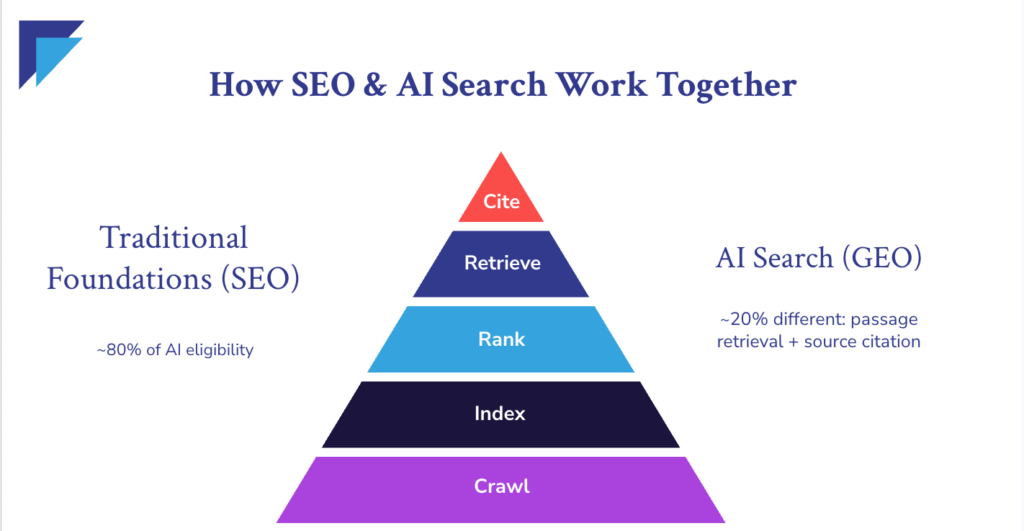
LLMs view your university as a “knowledge graph,” similar to a word web connecting entities to other nodes of information. AI uses this information to create a robust picture of a topic or entity.
The AI tool takes a user’s prompt and evaluates it to understand intent. The tool then vectorizes the prompt — a mathematical process of turning text, video, or images into a mathematical representation — and compares it against its training data. Training data can be inaccurate due to the dataset’s age, so the tool compares the assembled answer against live data before compiling a final answer to be served to the user.
That last component uses Google’s search index, third-party search application programming interfaces (APIs), third-party websites, and the entity’s own website to create a detailed answer. So, if you have any inaccuracies on your site or on a third-party site, that will increase the likelihood of an incorrect answer. Any missing information about your brand or program leads to two potential outcomes. First, your institution is less likely to appear in an LLM answer. Second, the LLM may hallucinate and provide inaccurate, made-up information.
How Prospect Students Get Redirected
In an ideal world, your university would be featured accurately in every answer. In real-world practice, visibility relies on having the freshest information, relevant authority, and unique content. When these things don’t align, that can create a gap in coverage around a topic or unique value proposition.
Anecdote time: During a call, I had a partner search for one of their programs. Their program was ranked No. 1 in the state, but AI suggested a competitor down the street. Their competitor painted a better picture for student return on investment (ROI).
When outcomes are unclear, AI will look to evaluate your program or university against a competitor with a more complete picture. At Archer, we view content as a tool to help populate this knowledge graph. We evaluate those fan-out pathways to ensure that we’re providing prospective students and AI systems with the right content — content that helps prospective students evaluate their options and allows LLMs to provide a full picture.
The New Zero-Click Decision Path
Students are now engaging with LLMs and AI Mode in increasingly complex ways, leading to more sophisticated outputs. A look at what Google calls query fan-out, which powers the answer machine behind AI search, reveals a complex decision tree that guides prospective students along a conversational path.
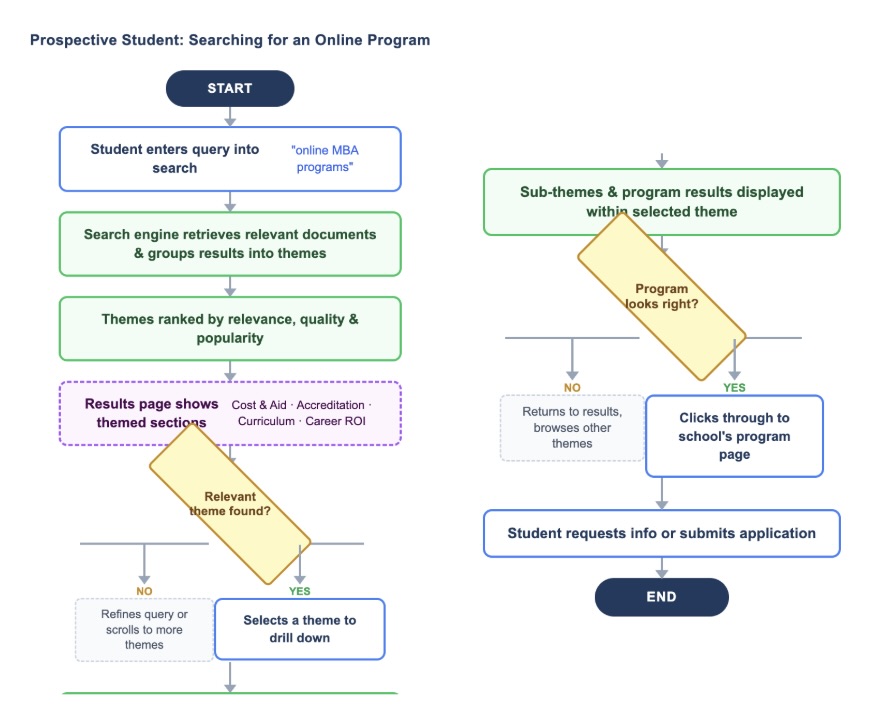
The search experience has evolved from a dynamic list of 10 blue links into a conversation with thousands of outputs meant to satisfy a student search without ever driving a click. University programs will be stacked and ranked against one another, resulting in a more rigorous evaluation process.
In this process, students interact with value propositions and never interact with your actual brand assets. They’re relying on third-party answers to fill the critical information gaps. This external process shapes conversion, with a prospective student applying without ever visiting a program page. This can lead to critical information gaps that hurt down-funnel conversion by introducing a potential point of incongruence.
Why Generic Content Fails in AI Summaries
When thinking about traditional SEO, content was focused on satisfying the intent of high-traffic search terms. This led sites across the web to create formulaic, generic content to satisfy search intent. According to a December 2025 study by Arxiv, LLMs and AI search systems prefer unique content that focuses on the sum of the parts rather than the whole. Let’s unpack why this works.
The Risk of Surface-Level Messaging
Let’s say you have a program page competing with high-authority university competitors such as Harvard or the Massachusetts Institute of Technology (MIT) for a general program query. Competing with sites that have more external citations lessens the likelihood that you’ll be cited. Shallow messaging with no unique value won’t be surfaced in AI search or in conversations with LLMs.
A lack of citation in AI search leads to complete exclusion from prospective student discovery in the new, deeper evaluative processes that AI offers. Not to be overly dramatic or hyperbolic, but smaller institutions risk erasure.
The Cost of Not Being Explicit
Instead of falling into the sea of sameness, you should focus on the nuances around your program. By providing university-specific context on student experience, faculty expertise, student outcomes, and institutional successes, you serve as a primary source, increasing the likelihood of being cited.
By not building unique content around your university brand and the value your programs provide prospective students, you run the risk of being excluded altogether from AI search. This lack of visibility will lead to declining enrollments, hurting the student experience and a university’s fiduciary responsibility.
Designing Content That Survives Zero-Click Evaluation
Getting in front of prospective students and shaping how they interact with your brand in these external systems has never been more important. Now that we’ve discussed how zero-click search and LLMs affect prospective student discovery and the student journey, let’s focus on some of the tactics that can help universities earn citations.
The answer lies within the outputs of your web and marketing teams. Is your institution creating content that explicitly highlights its unique value? Are you using institutional data to give your content an edge over your competitors?
Answer the Questions Students Actually Ask
When building content, ask yourself whether you’re writing it for an intended audience or for the web. Over my decade of experience in higher education, I’ve heard institutions and marketers refer to content as “SEO content.” When content is positioned and framed in this way, it raises a few red flags. It suggests to me that the institution doesn’t know its audience and that the content itself is of low value.
Great content is high-quality content that asks the right questions. It hits the informational nodes that matter to your audience. It highlights the ROI for prospective students by showcasing the outcomes and skills they’ll take away.
Good content also provides a semantic HTML structure that helps LLMs understand it while guiding the user down a path to the answers they’re looking for. It provides context into who this program is tailored to and why it should matter to them.
Build for Clarity, Not Just Conversion
Good content is concise content that provides relevant context rather than focusing solely on converting students. By working to create content that accurately reflects your program or institution, you’re providing unique value that informs a student’s evaluative process.
By clearly comparing your program to internal and external programs within similar fields, you create the context that enables AI to better align your content with the right audience. It also reduces friction by setting realistic expectations for prospective students.
Align Marketing and Admissions Around Pre-Click Influence
A great way to tackle building good content is to align your marketing and admissions teams. Admissions teams are marketing teams’ closers. They have firsthand experience with prospective students’ objections and decision-making processes.
By having these teams work together, a university can overcome objections by answering FAQs and shaping program messaging. This approach will also help LLMs shape the way they surface answers about your program.
Key Takeaways
- Zero-click search poses a risk to universities across the web by creating a landscape that deters prospective students from clicking through to university websites.
- AI search represents interactions that go beyond traditional key performance indicators (KPIs).
- Winning at AI search is driven by high-quality content that avoids generic messaging and provides unique value.
- Organized content that answers high-intent questions will drive visibility and ensure that LLM output aligns with your program.
- By creating content that aims to inform your prospective students and using AI tools, you’ll build areas of influence before a prospective student lands on your website.
Take Control of Your Visibility in an AI-First Search Landscape
As zero-click search reshapes how prospective students discover and evaluate programs, institutions can no longer rely on traditional tactics to drive visibility and engagement. Archer Education partners with institutions to navigate this shift with confidence with AI Ready Organic Strategy.
By aligning marketing, admissions, and content strategy, we can help you build a stronger presence across the entire student journey. Connect with Archer to learn how we can help you turn AI-driven discovery into a competitive advantage.